Red Heart Lucky Dice Embroidery Design
A Craft Fair Designer’s First Look: Bold, Playful & Instantly Recognizable
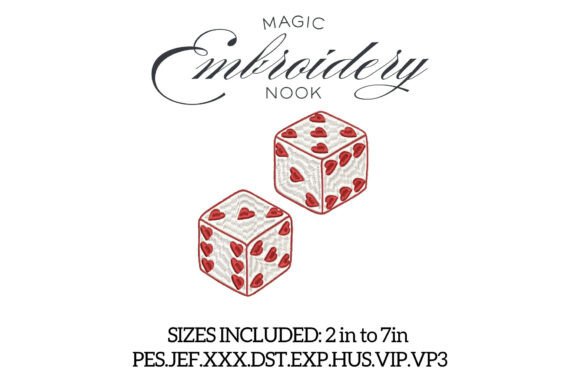
As someone who’s stitched, sold, and styled hundreds of embroidery designs for craft fairs and handmade markets, my first impression of the Red Heart Lucky Dice Embroidery Design is immediate: it’s bold without being loud, playful without feeling juvenile, and festive without leaning into cliché. The concept—a pair of white dice with red borders, pips swapped for vibrant red hearts—is clever, cohesive, and emotionally resonant. It lands somewhere between modern romantic and lighthearted luck—perfect for Valentine’s Day, yes, but also strong enough to carry through spring markets, gift shops, and year-round boutique displays. It doesn’t scream “farmhouse” or “minimalist.” Instead, it leans into cheerful graphic energy—clean lines, high-contrast color blocking, and a wink of nostalgia (dice + hearts = love + chance). That duality makes it unusually versatile.
Where This Design Shines on Real Craft Fair Products
The Red Heart Lucky Dice Embroidery Design performs exceptionally well across tactile, high-visibility items—exactly what moves at weekend markets. On a tote bag design, placed front-and-center above the seam, it reads instantly from six feet away. Its symmetrical layout and strong red/white contrast pop against natural canvas, denim, or oatmeal linen—no need for backing fabric to sell the idea. As apron embroidery, centered on the bib or subtly repeated on pockets, it adds personality without overwhelming utility. For tea towel embroidery, it holds up beautifully on terry cloth or waffle weave—if you use the right stabilizer—because the heart shapes avoid fine-line fragility while still delivering charm.
It’s especially effective as an embroidered patch: small, self-contained, and ready for iron-on or sew-on application. Buyers love grabbing patches for quick personalization—caps, denim jackets, backpacks—and this one stands out in a mixed display. On fabric pouches and small market bags, it works equally well at 2.5" or scaled up to 4". As a pillow cover motif, it anchors a neutral linen or cotton base with just enough visual weight—not too sweet, not too stark. And for handmade gifts like embroidered keychains or mini hoop art, it delivers instant emotional appeal: love, luck, and a touch of wit.
What Makes It Sell—Beyond the Stitch
This isn’t just a pretty machine embroidery design; it’s a smart craft fair product engine. Why? First, it’s glanceable: no decoding needed. A customer sees hearts + dice and gets the message—“love is lucky,” “chance meets affection”—in under two seconds. Second, it scales cleanly. Whether used as a tiny accent on a cap brim or a bold focal point on a tote, the geometry holds. Third, it photographs with exceptional clarity for Etsy seller listings and printable mockups. Red thread pops against white or light fabric in natural light—critical for scroll-stopping thumbnails. Finally, it feels repeatable: batch-producing 20 matching aprons or 50 tea towels won’t fatigue your machine or your eye. The stitch density appears balanced—not so dense it gums up terry cloth, not so sparse it loses definition on dark fabric.
Careful-Use Notes Every Embroidery Designer Should Check
- Dense stitch areas: The heart-shaped pips may cluster tightly—test on scrap fabric to confirm no puckering or thread breakage, especially at smaller sizes.
- Tiny details: While the hearts are larger than traditional pips, verify that the smallest version (e.g., for a cap front) retains shape and clarity—avoid going below 1.75" wide total unless verified.
- Textured towels & thick fabric: Use cutaway stabilizer + medium-weight tear-away for terry or heavy linen; skip lightweight mesh—it won’t support the clean edges this design needs.
- Curved cap surfaces: Hoop carefully—center the design over the crown curve, not the flat front panel, to prevent distortion.
- Dark fabric: If stitching on navy, charcoal, or black, confirm red thread has sufficient brightness—some “red” poly threads dull on darks. Consider a slightly brighter red or even a cherry-toned alternative.
How It Elevates Your Booth, Brand & Buyer Connection
In a crowded craft fair aisle, the Red Heart Lucky Dice Embroidery Design draws attention without shouting. It adds visual rhythm to your table—pair it with soft neutrals, kraft paper tags, and matte ceramic mugs to let the red pop. It strengthens brand consistency if you’re building a line around “lucky love” or “playful sentiment”—think coordinating tea towels, patches, and pouches all sharing the same motif. More importantly, it sparks conversation: customers point, smile, and say, “Oh! That’s us.” That emotional hook translates directly to higher buyer engagement and stronger perceived handmade quality. Unlike overly literal Valentine’s motifs, this design feels fresh, intentional, and commercially savvy—not just seasonal, but story-driven.
Practical Embroidery Designer Notes Before You Cut Fabric
Before launching production, run these checks: test the digital embroidery file on scrap fabric matching your final product (canvas, terry, twill); verify thread contrast across your intended fabric colors; review spacing between hearts and borders—tight gaps can vanish on textured surfaces; confirm your hoop size accommodates the full design comfortably; inspect stitch density in the heart centers—adjust if needed for your machine’s tension; choose stabilizer based on fabric texture, not habit; create at least one real-life finished product mockup—not just digital—and hold it in market lighting; compare how it reads on ivory vs. bright white fabric; and absolutely confirm commercial licensing applies before selling embroidered goods—this is non-negotiable for small shop product and commercial embroidery use.
Final Thought: A Design That Works as Hard as You Do
The Red Heart Lucky Dice Embroidery Design isn’t just another Valentine S Day option—it’s a strategic embroidery asset. It balances emotion and execution, charm and clarity, trend-awareness and timelessness. For Etsy sellers, boutique makers, Cricut crafters, and anyone building a scalable handmade product line, it’s a rare find: simple to produce, strong to sell, and memorable to buyers. Bring it to your next craft fair booth—and watch it roll straight into carts.